
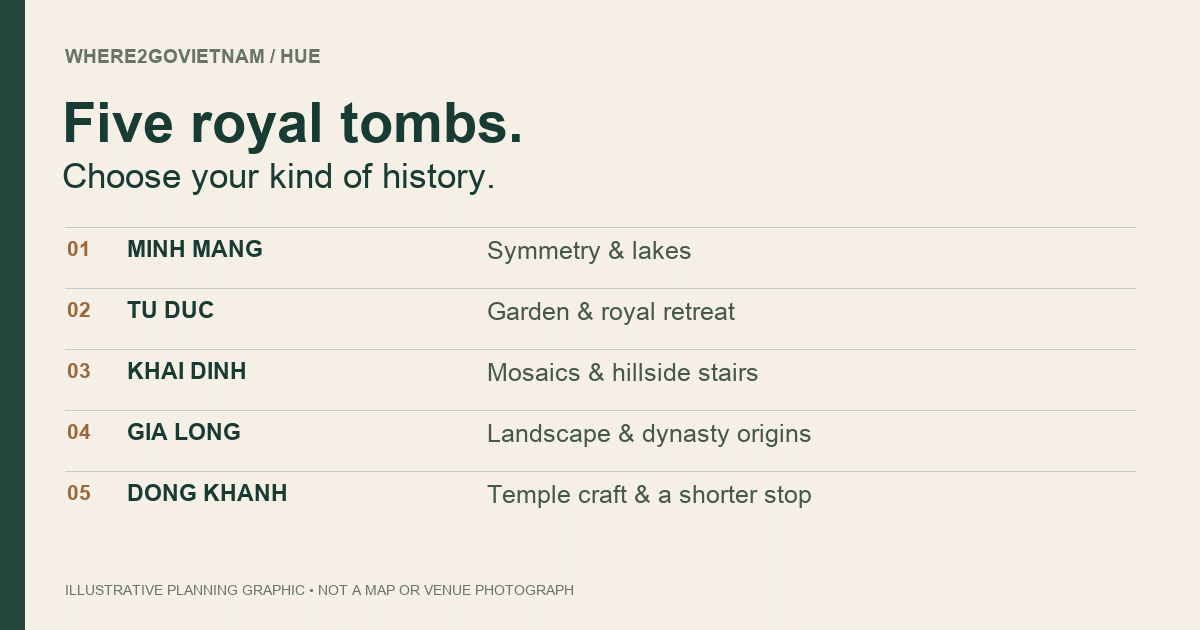
The Hue royal tombs offer five very different reasons to leave the city centre. Choose Minh Mang for formal landscapes, Tu Duc for a lakeside royal retreat, Khai Dinh for ornate interiors, Gia Long for the dynasty’s origins in a broad countryside setting, or Dong Khanh for temple craftsmanship. For a first visit, two contrasting tombs are usually more rewarding than trying to collect all five.
This guide compares what you will see, how much time to leave and which tombs make sensible pairs. Visit durations below are planning estimates for time inside each complex, excluding transport, queues and breaks. Ticket information was checked against official Hue sources on 17 November 2026; confirm your chosen sites and any temporary restrictions before travelling.
Hue royal tombs compared: which should you visit?
| Tomb | Choose it for | Estimated visit | Route and access trade-off |
|---|---|---|---|
| Minh Mang (Minh Mạng) | Symmetrical courts, lakes and pavilions | 75–120 minutes | Outlying southwest circuit; sustained walking and changes of level |
| Tu Duc (Tự Đức) | A garden-like retreat with lakeside buildings | 75–120 minutes | Pair with nearby Dong Khanh; paths and steps, with some interiors affected by restoration |
| Khai Dinh (Khải Định) | Decorative mosaics and a contrasting architectural style | 45–75 minutes | Pair with Minh Mang for variety; a pronounced stair climb |
| Gia Long | Landscape, royal family history and the dynasty’s founder | 75–120 minutes | Allow a separate countryside outing or pair with Minh Mang; spread-out grounds and steps |
| Dong Khanh (Đồng Khánh) | Ngung Hy temple and a more compact architectural study | 45–60 minutes | Useful second stop near Tu Duc; temple and burial areas still involve walking |
Our first-visit recommendation: choose Minh Mang and Khai Dinh if you want a clear contrast between landscape design and elaborate decoration. Choose Tu Duc and Dong Khanh if you prefer a geographically focused outing. If walking or stairs are difficult, discuss the actual entrance-to-viewpoint route with the heritage centre before buying tickets: none of these recommendations is a verified step-free route.
1. Minh Mang Tomb: choose it for symmetry and landscape
Minh Mang’s tomb, also called Hieu Lang, is the strongest choice for understanding how a royal complex uses space. Gates, courts and buildings follow an ordered axis, with water and hills framing the architecture. The Hue heritage discovery guide to Minh Mang Tomb describes a roughly 700-metre depth from the principal gate to the rear enclosure and a location about 12 kilometres from Hue.
The useful way to visit is to pause at successive thresholds and look back as well as forward. The relationships between the gates, water and pavilions explain more than a quick photograph of a single building. Give this tomb the longer visit if you enjoy garden design, architectural composition or a deliberate walk.
Route choice: make it the main stop of a southwest outing, then add Khai Dinh for a different visual experience. Minh Mang and Gia Long also have an official paired ticket, but leave space for the transfer and for Gia Long’s grounds. A discounted ticket is not a reason to compress both into a short gap before a train.
2. Tu Duc Tomb: choose it for a lakeside retreat
Tu Duc’s tomb, or Khiem Lang, combines a funerary complex with buildings used during the emperor’s lifetime. Luu Khiem Lake and its pavilions make the landscape central to the experience. The local heritage account of Tu Duc Tomb identifies the lake, Hoa Khiem Palace and Minh Khiem theatre among its principal features.
Choose Tu Duc if you prefer to move between garden views and smaller architectural details rather than follow a single grand axis. It rewards time by the water as well as time in the monumental areas. Keep your route flexible so that a closed building does not become the centrepiece of your visit.
Restoration caveat: reporting in August 2026 described Minh Khiem theatre as closed during restoration. Work on several structures has continued through 2026; a projected completion date does not confirm visitor access. Check the Hue Monuments Conservation Centre’s current information before making a special trip for an interior. Do not assume the theatre is open or that a performance is included.
Route choice: combine Tu Duc with Dong Khanh, rather than crossing the whole tomb circuit for one additional stop. Their official paired ticket supports this choice, and the second complex adds a different architectural emphasis.
3. Khai Dinh Tomb: choose it for mosaics and dramatic stairs
Khai Dinh’s tomb, or Ung Lang, is the clearest stylistic change from the lakeside complexes. Its hillside terraces lead towards an intensely decorated interior. The heritage centre’s Google Arts & Culture presentation of Khai Dinh Tomb explains the combination of Eastern and Western influences; porcelain and glass decoration are central to its appeal.
This is our pick if you are most interested in surfaces, materials and close-up detail. Budget time to examine the decoration rather than treating the top of the staircase as the finish line. Its more concentrated footprint can suit a shorter visit, but that does not make the approach physically easy.
Access trade-off: the climb is part of the visit. If someone in your group struggles with stairs, do not choose Khai Dinh simply because its suggested visit is shorter. Rain also changes how comfortably you can manage the exposed approach; footwear with grip matters.
Route choice: pair it with Minh Mang and give each enough time to register. If you have already spent a long morning at the Imperial City, consider doing only one tomb that afternoon.
4. Gia Long Tomb: choose it for landscape and the dynasty’s beginnings
Gia Long’s tomb, also known as Thien Tho, belongs to the founder of the Nguyen dynasty. The Hue Department of Tourism’s account of Gia Long’s mausoleum describes a larger royal burial landscape, including the emperor and Empress Thua Thien, with distinct burial, worship and stele areas. Construction ran from 1814 to 1820.
Choose it when the setting matters as much as individual buildings. It makes most sense for travellers who want to explore how royal monuments sit within the surrounding hills, or who already know the more frequently included tombs. The extra journey is harder to justify if all you want is a quick architectural stop.
Route choice: agree on the exact tomb entrance and return collection point with your driver. Allow a half-day outing for Gia Long alone if you want an unhurried visit with transfers and breaks. If combining it with Minh Mang, reserve a generous part of the day rather than assuming the paired ticket represents a quick loop.
5. Dong Khanh Tomb: choose it for temple detail near Tu Duc
Dong Khanh’s tomb, or Tu Lang, offers another expression of the dynasty’s changing architecture. Ngung Hy temple is a particular reason to visit: traditional timber, decorative craft and the complex’s later architectural elements give you details to compare with the other tombs. The Hue discovery guide to Dong Khanh Tomb covers the temple and burial architecture separately.
This is a useful second visit for someone who enjoys looking closely at construction and decoration. Treat it as a distinct monument, with time for both its worship and burial areas. If you only have time for one tomb in Hue, our recommendation remains one of the first three, chosen around your interests and mobility.
Route choice: pair it with Tu Duc. Confirm the route between their visitor entrances rather than following a straight line across a map; nearby monuments do not necessarily share an entrance or a through-path.
Tickets, opening hours and temporary restrictions
The Hue City Portal’s official tariff lists adult single-site admission at 150,000 VND each for Minh Mang, Tu Duc, Khai Dinh and Gia Long, and 100,000 VND for Dong Khanh. For children aged 7–12, Minh Mang, Tu Duc and Khai Dinh are 30,000 VND each; Gia Long and Dong Khanh are free.
Two adult paired tickets are particularly relevant: Minh Mang + Gia Long costs 240,000 VND, and Tu Duc + Dong Khanh costs 200,000 VND. The official 2026 monument visitor information sheet gives these two-site tickets a maximum validity of 48 hours from the first visit. Choose your monuments before choosing a ticket; check the exact included sites and validity at purchase. Buy through the official Hue heritage e-ticket service or monument counters.
That sheet lists ticket-counter hours of 06:30–17:30 from 16 March to 15 October, and 07:00–17:00 from 16 October to 15 March. Entrance gates close 30 minutes after ticket sales end, and exit gates 60 minutes after. Arrive early enough for your whole visit; the last ticket-sale time is too late for an unhurried tour of a large complex.
Published hours do not guarantee access on a particular day. Check current heritage-centre notices during heavy rain and ask which buildings are accessible during restoration, especially at Tu Duc.
How to plan a route without rushing
- A half-day with contrast: Minh Mang and Khai Dinh, with pre-arranged transport and enough time for the longer walk at Minh Mang. If traffic, heat or queues reduce your available time, keep one tomb rather than rushing both.
- A focused half-day: Tu Duc and Dong Khanh. Leave room for breaks and ask about Tu Duc’s restoration restrictions before committing.
- A landscape-focused outing: Gia Long on its own, or Gia Long and Minh Mang over a generous day with a lunch break.
- All five: split them over at least two sightseeing days. Avoid adding the entire Imperial City to a day already devoted to several outlying tombs.
These are suggested time budgets, not timed tours. For a driver booking, confirm the named stops, waiting time, return transfer and whether tickets, parking or a guide cost extra. For a boat trip, ask which landing you use and how you reach the tomb entrance; a Perfume River cruise is not automatically a complete tomb transfer.
Wear comfortable walking shoes, carry water and cover shoulders and knees for worship areas. Plan demanding walks earlier in the day and leave space for meals and rest. When fitting Hue into a longer journey, use our Vietnam travel itinerary planning guide to avoid stacking major heritage visits against a departure deadline.
Hue royal tombs: practical FAQs
Which Hue royal tomb is best if I can visit only one?
Choose Minh Mang for formal landscape architecture, Tu Duc for lakeside scenery, or Khai Dinh for ornate decoration. Khai Dinh involves a substantial stair climb; Tu Duc’s interior access needs checking while restoration continues.
Can I visit all five tombs in one day?
We recommend at least two days for all five. Transport, walking, breaks and time to understand each complex make an all-five day a poor default, particularly if you also want to visit the Imperial City.
Are the tombs inside Hue Imperial City?
No. They are separate complexes outside the central Imperial City. Plan transport between the city and your selected tombs, and check the precise sites covered by any combination ticket.
Do I need a guide?
A guide is useful if you want help interpreting the symbolism, emperors and differences between complexes. A driver provides transport unless guiding is explicitly included; clarify that distinction when booking.
Which tomb should I choose if stairs are difficult?
Start by checking the exact visitor route with the conservation centre. Khai Dinh is the least suitable default for someone avoiding a steep stair climb, but the other tombs also have steps and uneven or lengthy paths. None is presented here as independently verified wheelchair-accessible.
1 thought on “5 Hue Royal Tombs to Visit and How to Choose Between Them”