
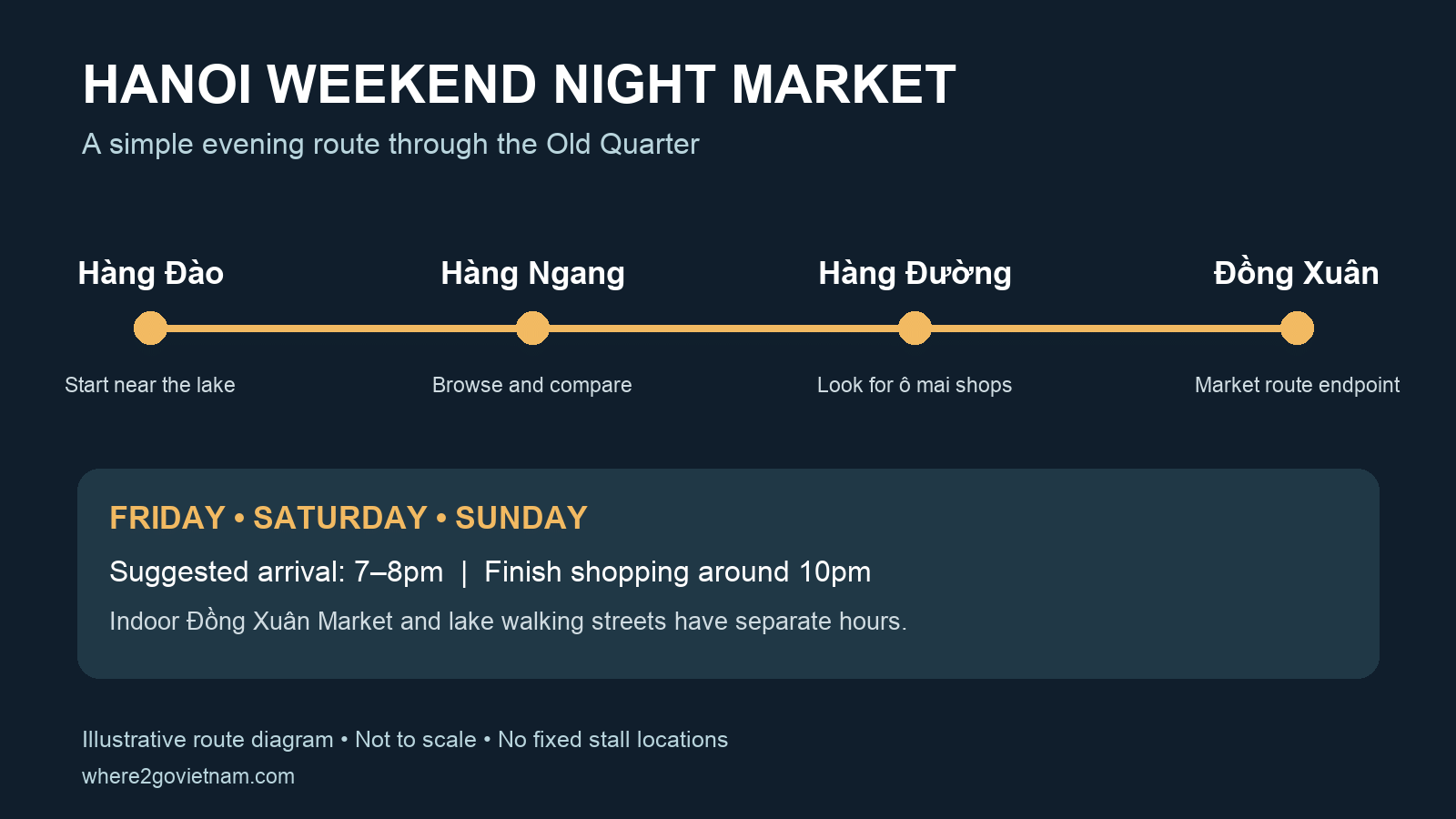
For most visitors searching for Hanoi night markets, the place to plan around is the Old Quarter weekend night market: an outdoor shopping route running from Hàng Đào through Hàng Ngang and Hàng Đường toward Đồng Xuân Market. Go on Friday, Saturday or Sunday evening, browse before buying, and leave room for a snack or dinner nearby.
Allow about two hours for a relaxed visit. Our suggested arrival window is 7–8pm, with shopping finished by about 10pm. That leaves a buffer before the published closing times, which differ between tourism listings. Entry is free; food, purchases and transport are separate.
Hanoi night market at a glance
| Your priority | Where to focus | What to expect |
|---|---|---|
| Weekend market shopping | Hàng Đào–Hàng Ngang–Hàng Đường toward Đồng Xuân | Outdoor stalls; Friday–Sunday evenings |
| An edible gift | Permanent shops on Hàng Đường | Packaged ô mai; shop hours are separate from the stalls |
| A full meal | Nearby Old Quarter restaurants and the Tạ Hiện area | A separate food stop, with menus and opening times to check |
| A walk without shopping | Hoàn Kiếm Lake | The lake walking area is distinct from the market route |
| Indoor market browsing | Đồng Xuân Market building | Plan a separate daytime visit; night stalls do not mean the building is open |
11 things to eat, buy and know
1. Choose a weekend evening and arrive before the final hour
The Vietnam tourism database lists Đồng Xuân night market from 6pm to 10:30pm on Friday, Saturday and Sunday. MyHanoi’s Old Quarter night market listing gives the same days but an 11pm finish. Treat 6pm as the approximate start of the evening, rather than a promise that every stall will already be ready.
Arriving at 7–8pm is a practical compromise: time to compare goods and eat without relying on late trading. For a particular holiday or a night of heavy rain, ask your accommodation to confirm local arrangements before setting out.
2. Follow the street names rather than a single map pin
Start at the Hàng Đào end near Đông Kinh Nghĩa Thục Square, north of Hoàn Kiếm Lake. Continue along Hàng Ngang and Hàng Đường toward the front of Đồng Xuân Market. Hanoi’s broadcaster confirms this sequence in its Old Quarter night market report.
Save both endpoints on your phone. A pin for “Dong Xuan Market” can send you directly to the building when you intended to browse the street stalls from the lake. Walk in one direction first, then decide whether any purchase deserves a return trip.
3. Choose one freshly prepared street snack
Food is part of the evening, but avoid making your whole dinner depend on finding a specific mobile vendor. Take a look at the stalls operating that night and choose a small portion prepared in front of you. Confirm the price and what the portion includes before ordering.
If you see skewers or fried snacks, ask what they contain and have them cooked thoroughly. A vegetable-looking filling or dipping sauce does not establish that something is vegetarian: check fish sauce, shrimp paste and meat ingredients. For a serious allergy, choose somewhere that can explain its ingredients clearly.
4. Buy ô mai on Hàng Đường
Ô mai, preserved fruit with sweet, sour, salty or ginger flavours, makes a compact food souvenir. A specific shop to look for on the route is Hồng Lam at 11 Hàng Đường, listed in both the national tourism shop directory and the brand’s own store information.
The Hồng Lam ô mai range includes ginger apricot and sấu fruit varieties. Compare the flavour descriptions rather than assuming every preserved fruit is simply sweet. Check package weight, ingredients and expiry date, and choose sealed packaging if you are taking it home. This is a permanent shop stop; its opening hours need checking independently of the weekend market.
5. Make a deliberate dinner detour
If you want a proper meal, leave the shopping flow and choose a nearby restaurant with a visible menu. Tạ Hiện and its surroundings are a separate food-and-drink area; they are not another name for the Hàng Đào market.
Before taking a seat, check the price of the dish, drinks and any extras you order. If you are more interested in Hanoi dishes than souvenir shopping, use our guide to local food in Hanoi to decide what you want to eat first, then fit the market around dinner. Do not assume every daytime speciality will be available late in the evening.
6. Inspect clothes before agreeing a price
Clothing is one of the market’s established product categories. Buy something because the actual garment suits you: examine seams, fabric thickness, fastenings and the printed design. Compare dimensions with something you own rather than relying entirely on a size label.
Ask whether an exchange is possible before paying. With a temporary stall, returning another night may be inconvenient. Treat a prominent brand logo as a reason to ask more questions about provenance, rather than proof of authenticity.
7. Keep souvenir purchases small and intentional
A small keepsake can be a better purchase than an armful of things chosen in a crowd. Compare similar items at a few stalls, then inspect the exact piece you will receive. Look for secure attachments, clean edges and printing that will survive the trip home.
For gifts with a particular material or place of origin in mind, read our Hanoi souvenir shopping guide before visiting. Browsing here is useful; a low asking price alone does not establish where an item was made.
8. Ask what “handmade” means before buying a craft
Handicrafts also feature in the market’s product mix. If that is what draws you here, ask who made the piece, where it was produced and what material it uses. A seller who can explain the work gives you more to assess than a generic “local handmade” label.
Check fragile edges and ask for suitable packing. For an expensive purchase, take time to compare specialist shops as well. The market works well for browsing, but a rushed decision under stall lighting is a poor way to judge workmanship.
9. Agree the total and keep your budget separate
There is no admission ticket to budget for. Your spending comes from what you choose to eat and buy, plus the journey there and back. There is no single reliable price list for independent stalls, so ask the price of the exact quantity or item in your hand.
Carry small Vietnamese đồng notes and a backup payment method. Do not assume a stall’s QR code works with your foreign banking app. If a price is negotiable, make a polite offer you would actually pay; accept a refusal and move on. Fixed-price shop labels call for a different approach.
One useful budget method is to reserve your return fare first, decide your dinner allowance second, and set a separate shopping limit. That keeps an inexpensive evening from growing purchase by purchase.
10. Arrange transport to the edge of the walking area
Plan to finish the journey on foot. For the July–December 2026 trial period, the Hanoi municipal investment fund’s traffic report describes vehicle restrictions in the Hoàn Kiếm walking and night-market area between 7pm and midnight on Friday, Saturday and Sunday. This traffic window is separate from stall opening hours.
Ask your driver for a legal drop-off near the area’s edge and agree a reachable pickup location for later. Follow barriers and police directions; do not assume an app pin guarantees vehicle access. If your hotel is inside the Old Quarter, walking may simplify the trip, provided the distance and conditions suit you. Recheck access arrangements for travel after the trial period.
11. Finish at the lake, with room to change your plan
You can combine the market with Hoàn Kiếm Lake, but give each its own place in the evening. The stalls are a linear shopping route north of the lake; a lakeside stroll is a separate activity. Road closures continuing later do not mean market sellers will still be trading.
Choose a meeting point before entering a crowd, keep valuables secured and pause at the side rather than in the main flow. If children get tired or the weather turns, shorten the market visit. A small bag and comfortable shoes make it easier to change direction than luggage or several bulky purchases.
A simple two-hour evening plan
7pm: Start near the Hàng Đào end and browse without buying immediately. 7:45pm: Continue along Hàng Đường, stopping for packaged ô mai if the shop you want is open. 8:15pm: Reach the Đồng Xuân end, then choose between dinner nearby and returning toward the lake. These are suggested timings, not an organised tour schedule; queues, crowds and shopping stops can stretch them.
If you arrive hungry, reverse the priorities: eat first, browse second. If shopping is your main goal, compare stalls before the last part of the evening. For bars and other activities after your market visit, see our separate Hanoi nightlife guide.
Questions about Hanoi night markets
Is Hanoi’s Old Quarter night market open every night?
The weekend street market described here runs on Friday, Saturday and Sunday evenings. Permanent shops, restaurants and other Hanoi markets have their own schedules; seeing them open on a weekday does not mean the weekend stalls are operating.
What time does the market close?
The tourism database lists 10:30pm; MyHanoi lists 11pm. Aim to finish shopping by about 10pm and confirm arrangements locally around holidays or poor weather. Do not use the midnight traffic-restriction time as a stall-closing time.
Is Đồng Xuân Market the same as the night market?
No. Đồng Xuân is the indoor market building at the northern end of the route. The weekend night market consists of outdoor stalls along the surrounding street route. Visit the building separately during the day if that is what you want to explore.
Can I visit on a weekday instead?
You can explore the Old Quarter, visit permanent shops and eat nearby on a weekday, subject to each business’s hours. You will need a weekend evening for this particular outdoor market. A weekday visit is an alternative Old Quarter outing, rather than the same market with fewer people.
Is it worth going if I do not want to shop?
Yes, if you enjoy a busy evening stroll and browsing. Keep the visit short and combine it with dinner or the lake. If crowds and repeated shopping stops sound tiring, plan a meal and lakeside walk instead of making the full market route compulsory.