
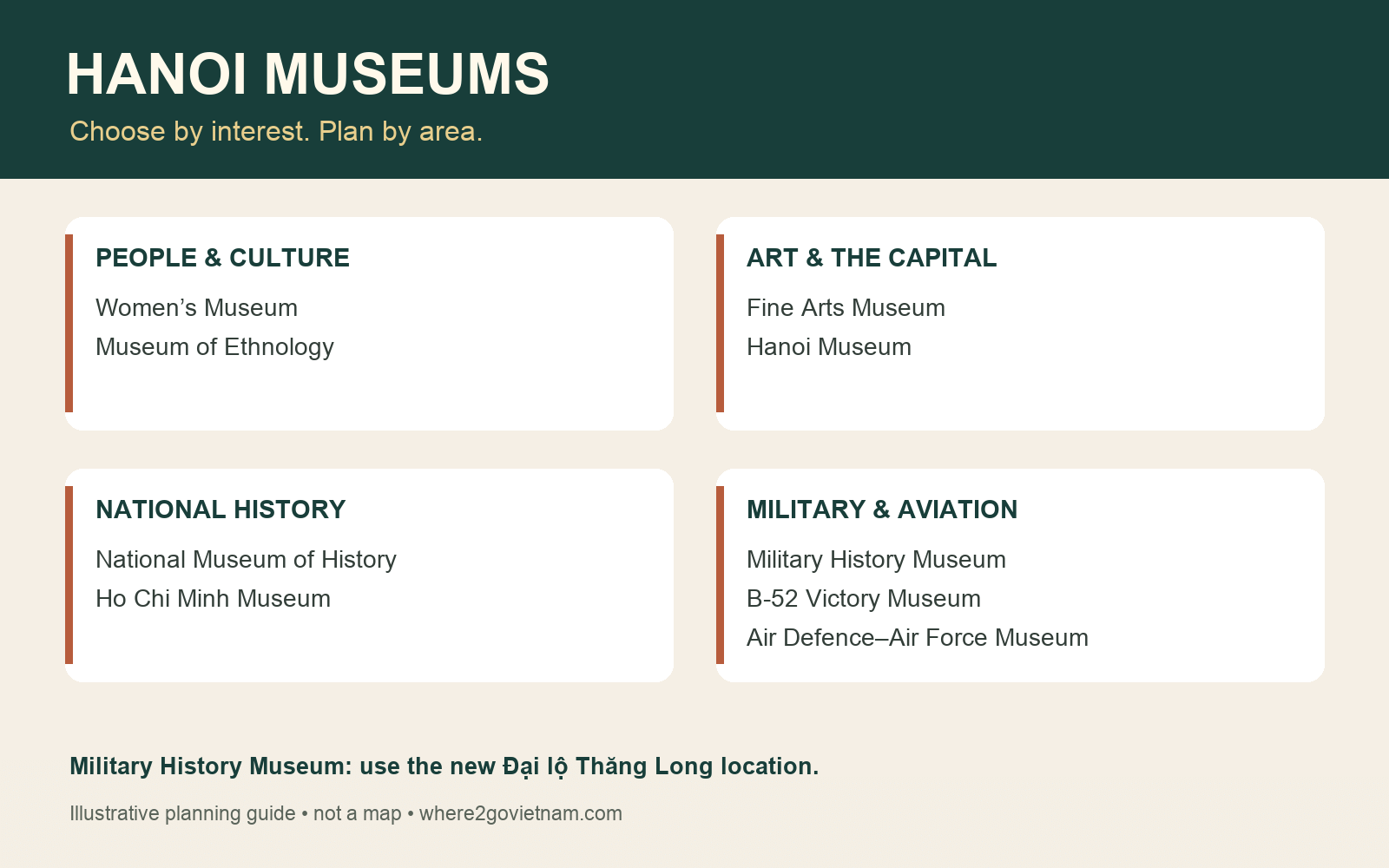
The best museums in Hanoi depend on what you want to understand. Start with the Vietnamese Women’s Museum for family life, clothing and personal histories; choose the Museum of Ethnology for cultural diversity and traditional houses; or head to the Fine Arts Museum for a visit centred on art. Military history deserves more planning: the Vietnam Military History Museum has moved west to Đại lộ Thăng Long, away from its old address beside the Flag Tower.
You do not need to visit all nine. One museum and a neighbourhood walk usually make a more rewarding half-day than racing between collections. This guide compares interests, locations, admission and closing days so you can choose a museum that fits your trip.
Compare the best museums in Hanoi
Prices below are standard adult admission in Vietnamese dong unless stated otherwise. Visit lengths are suggested planning allowances, excluding transport. Holiday arrangements, temporary exhibitions and guided services can differ.
| Museum | Choose it for | Area | Allow | Admission and opening-day watch |
|---|---|---|---|---|
| Vietnamese Women’s Museum | Family traditions, dress and women’s histories | South of Hoàn Kiếm Lake | 1–2 hours | 40,000 VND; daily, 08:00–17:00 |
| Vietnam Museum of Ethnology | Cultural diversity and house architecture | Nguyễn Văn Huyên | 2–3 hours | 40,000 VND; 08:30–17:30, closed Monday and Lunar New Year |
| Vietnam National Fine Arts Museum | Vietnamese art | Near the Temple of Literature | 1½–2 hours | 40,000 VND; Tuesday–Sunday, 08:30–17:00 |
| Vietnam National Museum of History | Archaeology and historical context | Tràng Tiền / Trần Quang Khải | 1½–3 hours | 40,000 VND published adult fee; closed Monday, midday break |
| Vietnam Military History Museum | Military campaigns and large equipment | Đại lộ Thăng Long, western Hanoi | 2–3 hours | 40,000 VND; closed Monday and Friday, midday break |
| Ho Chi Minh Museum | Hồ Chí Minh’s life and political history | 19 Ngọc Hà, Ba Đình | 1–1½ hours | 40,000 VND for international visitors; Vietnamese visitors free; closed Monday and Friday |
| Hanoi Museum | The capital’s history and architecture | Phạm Hùng, Từ Liêm | 1½–2½ hours | 50,000 VND; Tuesday–Sunday, 09:00–17:00; evening opening announced for Friday/Saturday |
| B-52 Victory Museum | Hanoi’s air defence and the 1972 air campaign | 157 Đội Cấn | 45–90 minutes | City tourism listing says free; confirm gallery hours and closed days |
| Air Defence–Air Force Museum | Military aviation and air-defence equipment | 173C Trường Chinh | 1–2 hours | Confirm current fee and public gallery schedule before travelling |
1. Vietnamese Women’s Museum: a central introduction to everyday life
Address: 36 Lý Thường Kiệt, Hanoi.
This is a useful first museum if you want human stories alongside historical events. Displays connect women’s roles in family life, clothing and wartime experience. It also makes a manageable choice when you have limited time and are staying around Hoàn Kiếm.
Choose it over a military collection if you are more interested in how people live, marry, dress and contribute to society than in campaigns and equipment. Take time to compare the clothing and family customs rather than treating them as a single national tradition.
The national tourism authority’s museum guide lists admission at 40,000 VND and opening from 08:00 to 17:00 daily. It is a useful Monday option. Afterwards, explore the surrounding streets with our Hanoi French Quarter guide.
2. Vietnam Museum of Ethnology: cultural diversity and traditional houses
Address: Nguyễn Văn Huyên Street, Nghĩa Đô, Hanoi.
The Museum of Ethnology is the strongest choice here for putting Vietnam’s different communities into context. Its indoor displays and outdoor architecture garden make a varied visit: objects explain daily life, while the house structures help you understand how buildings relate to their inhabitants.
Allow enough time for both parts. A rushed indoor circuit misses much of the reason to travel here. For families, choose a few objects or buildings to compare together rather than trying to read every panel.
The museum’s fee page lists standard admission at 40,000 VND. The official visitor information gives 08:30–17:30 opening, with Monday and Lunar New Year closures. This is outside the Old Quarter walking circuit; arrange transport and keep an indoor alternative for heavy rain.
3. Vietnam National Fine Arts Museum: the best fit for art interests
Address: 66 Nguyễn Thái Học, Hanoi.
Choose the Fine Arts Museum when you want time with paintings and sculpture rather than another historical timeline. Comparing materials and artistic approaches can be rewarding even if you arrive with little background in Vietnamese art. Pick a work you like, then look for another treatment of a similar subject elsewhere in the galleries.
Its location near the Temple of Literature makes this one of the easiest museum visits to combine with a major central attraction. Give the art its own time slot; trying to squeeze it into the final minutes of an already full day leaves little room to look closely.
The museum’s official website lists Tuesday–Sunday opening from 08:30 to 17:00. The national tourism authority lists the adult ticket at 40,000 VND. Monday is the regular closed day.
4. Vietnam National Museum of History: archaeology and a longer historical view
Addresses: 1 Tràng Tiền and 216 Trần Quang Khải, Hanoi.
This is the better choice for a broader historical framework before visiting temples, archaeological sites or former imperial capitals. Its two addresses belong to one institution; do not count them as two separate museums or assume every gallery is in the building your driver first reaches.
The museum’s publications distinguish the earlier historical collection at Tràng Tiền from modern history at Trần Quang Khải. Decide which period interests you first and ask which displays are accessible that day. A visitor focused on archaeology can make a satisfying visit without attempting both collections.
The official museum website lists 08:00–12:00 and 13:30–17:00, closed Monday. Its published admission notice states 40,000 VND for adults; because that notice is longstanding, check the current ticket terms at the counter, including access to both addresses. Avoid arriving during the lunch closure.
5. Vietnam Military History Museum: plan for the new western location
Current location: Km 6+500, Đại lộ Thăng Long, Hanoi.
This museum moved to a purpose-built site west of the centre and opened there in November 2024. Do not travel to the former 28A Điện Biên Phủ address expecting the current museum collection. Use the full Vietnamese museum name and Đại lộ Thăng Long when checking your destination.
The People’s Army newspaper’s opening report confirms the new site. This is the substantial option for military history, with campaign interpretation and large equipment, rather than a quick addition to a central walking tour.
Cần Thơ’s tourism information lists 40,000 VND admission, opening 08:00–11:30 and 13:00–16:30, closed Monday and Friday. Reserve a half-day including travel. Check a live route and car fare from your actual starting point; return transport and outdoor walking matter more here than the modest entry fee.
6. Ho Chi Minh Museum: biography, symbolism and national history
Address: 19 Ngọc Hà, Hanoi.
The museum focuses on Hồ Chí Minh’s life and legacy. It suits visitors who want political and biographical context for the surrounding Ba Đình area. Some interpretation uses symbolic installations, so background reading or a guide can help connect what you see with the historical events.
The museum, mausoleum and other nearby visitor sites have separate access arrangements. A museum ticket does not establish admission to every stop around the square, and the museum’s timetable should not be used to plan a mausoleum visit.
The current official opening information gives Tuesday, Wednesday, Thursday, Saturday and Sunday, 08:00–12:00 and 14:00–16:30; Monday and Friday are closed. The official ticket page lists 40,000 VND for international visitors and free entry for Vietnamese visitors. Its ticket-sale cutoffs are earlier than gallery closing, so arrive comfortably before the end of either session.
7. Hanoi Museum: the city’s own story in a distinctive building
Location: Phạm Hùng Street, Từ Liêm, Hanoi.
Choose Hanoi Museum if your main question is how the capital developed. It brings the focus back from the nation as a whole to the city you are exploring. The inverted-pyramid building is part of its appeal, but allow time for the collection rather than travelling only for an exterior photograph.
Older free-entry descriptions are outdated. The museum’s admission announcement says charging began on 3 March 2026; the official Hanoi tourism listing gives 50,000 VND adult admission.
Regular opening is 09:00–17:00, Tuesday–Sunday. The museum also announced Friday and Saturday evening opening from 17:00 to 21:00 starting in September 2026. Check the current programme and ticket terms before planning an evening around it. This is another western-city destination, not an Old Quarter walk-in.
8. B-52 Victory Museum: a focused look at Hanoi’s air defence
Address: 157 Đội Cấn, Hanoi.
This specialist museum is a more focused choice for the air campaign over Hanoi and the capital’s armed forces. It can suit visitors who want a shorter military-history stop in the Ba Đình area instead of the journey to the much larger Military History Museum.
A 2026 Hanoi veterans’ association announcement confirms the museum at this address. The city tourism listing describes admission as free, but its broad time window does not establish a reliable indoor-gallery schedule. Confirm opening days and gallery access before a dedicated journey.
Use the museum’s name and Đội Cấn address when navigating. B-52 wreckage at Hữu Tiệp Lake is a separate site and should not be mistaken for the museum entrance.
9. Air Defence–Air Force Museum: for aviation enthusiasts
Address: 173C Trường Chinh, Hanoi.
This is a specialist alternative for visitors whose main interest is aircraft and air-defence equipment. It is separate from both the B-52 Victory Museum and the relocated Vietnam Military History Museum. Choosing one of these three according to your interests is usually more useful than assuming they offer interchangeable experiences.
The People’s Army newspaper identifies the museum at 173C Trường Chinh. Published visitor guides conflict on public opening days and fees. Confirm both with the museum before setting out, specifically asking about the indoor collection as well as outdoor displays.
Allow a separate transport leg from the centre. If you cannot confirm access, the centrally located Fine Arts or Women’s Museum makes an easier alternative with a published weekly schedule.
How to fit Hanoi museums into your itinerary
A central half-day with little transport
Choose the Women’s Museum or National Museum of History, then walk through the French Quarter and towards Hoàn Kiếm Lake. Pick one collection for the morning; add a second only if you still have energy and its afternoon session fits. Keep lunch flexible rather than booking a tightly timed transfer between galleries.
Art and historic architecture
Pair the Fine Arts Museum with the Temple of Literature. Begin with whichever matters most to you, leaving a proper break between them. For more ideas beyond museums, use our Hanoi attractions guide to build a broader day.
A western museum half-day
Choose Ethnology, Hanoi Museum or the Military History Museum as the main destination. They sit outside the central sightseeing circuit but are not all neighbours. Check the complete route before combining two; travelling west does not automatically make a three-museum day practical.
A taxi or app-booked car is useful when time is limited. Compare the outward and return quotes, allow traffic buffers and use the museum’s specific street address. Public buses can reduce costs, but routes, stops and walking connections should be checked for your departure point that day.
Practical tips before you buy tickets
- Plan the day before the route. Monday closures affect many choices here; the Military History and Ho Chi Minh museums also close Friday.
- Respect midday breaks. At the National History, Military History and Ho Chi Minh museums, a noon arrival can leave you waiting for the afternoon session.
- Budget beyond admission. Audio guides, special programmes, parking and transport may cost extra. For western museums, travel can be the larger expense.
- Ask about your actual needs. Confirm step-free routes, lifts, seating and accessible toilets directly if these determine whether a visit works for you.
- Check photography rules at the entrance. Rules can differ by exhibition and equipment; a general admission ticket is not permission for every type of photography.
Frequently asked questions
Which Hanoi museum should I visit if I only have time for one?
Choose the Women’s Museum for an accessible range of social and personal histories near the centre. Choose Ethnology if traditional houses and cultural diversity matter most, or Fine Arts if you would rather spend your time looking closely at art. Military-history enthusiasts should reserve a half-day for the new Military History Museum.
Which museum is a useful Monday option?
The national tourism authority lists the Vietnamese Women’s Museum as open daily. Many of the other major museums in this guide close on Monday. Check holiday notices before leaving, especially around Lunar New Year.
Where is the Vietnam Military History Museum now?
It is at Km 6+500 on Đại lộ Thăng Long in western Hanoi. The current collection is no longer at its former Điện Biên Phủ location beside the Flag Tower. Check the destination shown in your map or ride-booking app before confirming the journey.
Is Hanoi Museum still free?
No. Its official notice says admission charging began on 3 March 2026, and Hanoi’s tourism portal lists the standard adult ticket at 50,000 VND. Special concessions or free-entry occasions should be checked separately.
Are Hoa Lo Prison and the mausoleum included in these nine?
No. Hoa Lo is a historic prison site with exhibitions, while the mausoleum serves a different commemorative purpose. They can complement museum visits, but this list counts nine museum institutions rather than adding unrelated memorials to reach a number.